Dental Implant or Bridge: Which Is Right for a Missing Tooth?
If you have lost a tooth, the two most common fixed ways to fill the gap are a dental implant and a dental bridge. Here is how each one is fitted, what happens to the teeth next to the gap, how to look after each one, and what the dentist checks before suggesting one.
Reviewed by Dr. Athhar Maswood K, BDS, Reg. No. 46747 A, Karnataka State Dental Council
A gap from a missing tooth is more than a looks problem. It can make chewing harder on that side. Dental implants and bridges are the two common fixed ways to replace missing teeth. Both are fixed, so you do not take them out at night. Neither is right for everyone. The choice depends on the teeth next to the gap, your gums and bone, and your health. For how implants are done at Pristine Dental Clinic, see our page on dental implants in HSR Layout.
What a dental implant is
A dental implant is a small post, usually titanium, placed in the jawbone where the tooth root used to be. Once the bone has grown around it, a crown is fitted on top. Cleveland Clinic says an implant replaces the missing tooth without involving the neighbouring teeth.
What a dental bridge is
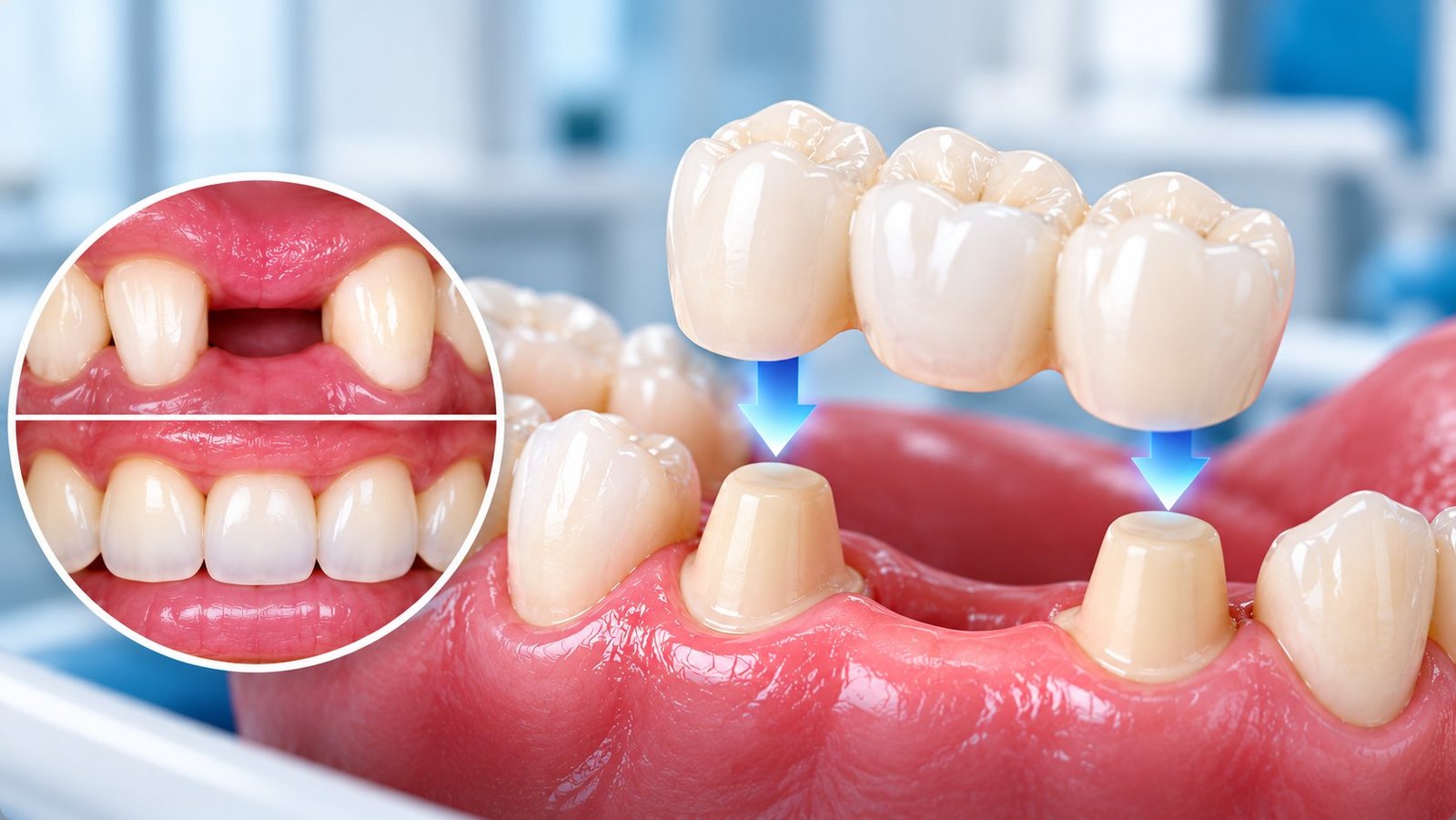
A bridge fills the gap with an artificial tooth (called a pontic) held in place by the adjacent teeth on either side (called abutments). The supporting teeth usually get a dental crown each. Cleveland Clinic lists four types:
Traditional bridge. Crowns on the teeth on both sides of the gap, with the false tooth between them. This is the most common type.
Cantilever bridge. Held by a crown on one side only. Cleveland Clinic says it is less strong than a traditional bridge.
Maryland bridge. Maryland bridges are held by metal wings bonded to the back of the teeth next to the gap. It is usually used for front teeth, because it cannot handle the chewing force at the back.
Implant-supported bridge. Rests on implants instead of natural teeth. Cleveland Clinic says it is used when three or more teeth are missing in a row.
With a traditional bridge, the bridge relies on the adjacent teeth for support. The teeth on both sides of the gap are shaped so the crowns can fit over them. Cleveland Clinic says this means removing some enamel, and that this step cannot be undone. The bridge also needs healthy teeth on both sides to hold it. If those teeth later get decay or are damaged, the bridge can be weakened.
With an implant, the surrounding teeth are not touched, because the implant is held by the bone, like a natural tooth root. Cleveland Clinic also says implants help preserve the jawbone, which can shrink after a tooth is lost.
How each one is fitted, and how long it takes
A traditional bridge usually takes two visits. At the first, the teeth are numbed and shaped, impressions are taken and a temporary bridge is fitted. Cleveland Clinic says the lab takes about two to four weeks to make the bridge. At the second visit, the bridge is checked and fixed in place.
An implant takes longer. The post is placed in the bone first. Cleveland Clinic says the bone can take three to nine months to grow around it. Then the crown is fitted, which takes about an hour. Some people need extra steps first, such as a bone graft. Our guide to dental implant steps explains each visit.
Looking after an implant or a bridge
An implant is cleaned like your other teeth: brushing, cleaning between the teeth and regular check-ups. Cleveland Clinic says to call the dentist if the implant feels loose, or the gum around it bleeds or swells.
A bridge needs one more step. Food and plaque can collect under the false tooth, so Cleveland Clinic advises cleaning under the bridge every day with a floss threader or a small interdental brush. It also advises avoiding very hard or chewy food, and not chewing ice, pens or fingernails.
Replacing more than one missing tooth
The choice can change when one or more missing teeth sit side by side. Cleveland Clinic says a bridge most commonly replaces one to three teeth in a row, and up to four is possible, but it needs healthy natural teeth on both sides of the gap to support the bridge.
When three or more teeth are missing in a row, Cleveland Clinic says an implant-supported bridge may be used. Here, implants hold the bridge instead of natural teeth. Implants can also hold a denture. The dentist explains which type of tooth replacement suits your gap after a check.
How long each one lasts
Cleveland Clinic says a bridge typically lasts five to 15 years, sometimes longer with good care. It says an implant can last for many years with brushing, flossing and regular dental visits, but the crown on top may need replacing at some point. Cleveland Clinic says most crowns and bridges on implants last around 15 years.
Implant vs bridge: pros and cons
Dental implant
Dental bridge
Teeth next to the gap
Not touched
Shaped for crowns (traditional bridge)
Time
Months, while the bone heals
Usually two visits, a few weeks apart
Surgery
Yes, to place the post
No
Cleaning
Like your other teeth
Also clean under the false tooth every day
Needs
Enough healthy bone and gums
Healthy teeth on both sides of the gap
A bridge needs no surgery and is usually finished sooner. An implant does not depend on other teeth and is cleaned like a natural tooth. The cost of each is different and depends on your case. At Pristine Dental Clinic, the dentist explains the cost of each option before you decide.
What the dentist checks before suggesting one
The teeth next to the gap: are they healthy enough to act as supporting teeth for a bridge, or do they already have large fillings or crowns?
Your gums and jawbone, seen on an X-ray: is there enough bone for an implant?
Your health: Cleveland Clinic says untreated gum disease, severe bone loss, diabetes that is not under control and smoking can make implants harder.
Your age: Cleveland Clinic says the usual minimum age for implants is 18, and bridges are usually not placed before 17 or 18.
Are the teeth next to my gap strong enough for a bridge?
Do I have enough bone for an implant?
How many visits does each option need, and over how long?
What is the total cost of each, including the crown?
How do I look after each one?
Not sure which suits your gap?
Book a check at Pristine Dental Clinic in HSR Layout. The dentist will look at the gap, take an X-ray if needed, and explain both options, the visits and the cost before you decide.
What is the difference between a dental bridge and an implant?
An implant is a post in the jawbone with a crown on top, and it does not touch the teeth next to the gap. A bridge is an artificial tooth held by crowns on the adjacent teeth, which are shaped to fit them.
Is a dental implant better than a bridge?
Neither is better for everyone. An implant does not touch the teeth next to the gap but needs surgery, healthy bone and a few months. A bridge is quicker but needs the teeth on both sides shaped for crowns. A dentist suggests one after a check.
How long does a dental bridge last?
Cleveland Clinic says a bridge typically lasts five to 15 years, and sometimes longer with good care and regular check-ups.
How long does a dental implant last?
Cleveland Clinic says an implant can last for many years with good care, but the crown on top may need replacing at some point, often after around 15 years.
Does a bridge damage the teeth next to it?
For a traditional bridge, the teeth on both sides are shaped so the crowns fit, which removes some enamel and cannot be undone. Those teeth also carry the bridge, so they need to stay healthy.
How do I clean under a bridge?
Cleveland Clinic advises cleaning under the false tooth every day with a floss threader or a small interdental brush, along with brushing twice a day and regular check-ups.
Missing a tooth? Call the clinic to talk about your options.
Pristine Dental Clinic, 1703, 19th Main Road, Sector 2, HSR Layout. Open every day, 9 am to 12 midnight.
This article gives general information. It is not a diagnosis and does not replace a check by a dentist. If you have swelling near your eye or neck, or trouble breathing, swallowing or speaking, go to a hospital emergency department straight away.