Pain After a Root Canal: What Is Normal, and How Long It Lasts
Some soreness after a root canal is common, and it usually settles on its own. Here is what most people feel in the days after treatment, how long it tends to last, what helps at home, and the signs that mean you should call the clinic.
Reviewed by Dr. Athhar Maswood K, BDS, Reg. No. 46747 A, Karnataka State Dental Council
After a root canal, many people are surprised that the tooth still feels a little sore. Mild pain after root canal treatment is common for a few days. Pain that gets worse, throbs or does not settle is not, and needs a call to the dentist. If you are planning treatment, our page on root canal treatment in HSR Layout explains how it is done at Pristine Dental Clinic.
Pain after root canal treatment: what most people feel
Root canal treatment is done with a local anaesthetic, so the tooth and gum are numb during the treatment. The NHS says your jaw and face may feel numb for several hours afterwards while the anaesthetic wears off.
Once the numbness goes, the area around the tooth may feel swollen and sore. Cleveland Clinic describes this as mild soreness, and says a root canal is usually no more painful than getting a filling. Some people also notice some tooth sensitivity, or discomfort when biting or chewing on that side. This pain or discomfort usually comes from the area around the treated tooth settling after the root canal procedure.
How long pain after a root canal lasts
For most people it settles quickly. Cleveland Clinic says most people recover in less than a week, and that some sensitivity may linger, but pain should not last beyond that. The NHS says the soreness and swelling should get better in a couple of weeks.
So the general picture is: a few days of mild soreness around the treated area, getting better each day. If the pain persists, gets worse instead of better, or is still there after about a week, contact your dentist.
How many sittings a root canal needs
The NHS says root canal treatment usually takes 2 or more appointments, each lasting 1 to 2 hours, or sometimes longer. Some teeth are finished in fewer visits, others need more. It depends on the infection and the shape of the roots inside the tooth.
Between sittings, the tooth is closed with a temporary filling until the permanent one is placed. Cleveland Clinic advises not to bite down on the treated tooth until the permanent crown is in place, because the tooth is not fully protected yet.
At Pristine Dental Clinic, the dentist tells you how many sittings your tooth needs after the examination and X-ray, before treatment starts.
What helps at home
Painkillers. The NHS says you can take paracetamol or ibuprofen if you are in pain. Follow the dose on the pack. If you take other medicines, ask your dentist or doctor which one suits you. If you are pregnant, ask your gynaecologist before taking any medicine.
Soft food for a few days. Cleveland Clinic suggests soft foods for a few days. At home this could be curd, khichdi, idli or dal rice. Chew on the other side.
Gentle cleaning. Keep brushing after meals and clean between your teeth once a day. Cleveland Clinic also suggests an antibacterial mouthwash.
No smoking. Cleveland Clinic says smoking can slow healing.
Care with the tooth. The NHS says to be careful not to bump or knock your mouth, and to go to your follow-up appointments.
Is it normal to have pain between root canal appointments?
Yes, some soreness between sittings is common. The NHS says the area around the tooth may feel swollen and sore, and the tooth is closed with a temporary filling until the next visit. Keep brushing gently, including around the temporary filling, and clean between your teeth. Do not bite hard on that side until the tooth is fully restored with its permanent filling or crown.
If the pain between appointments is severe, throbbing or getting worse, do not wait for the next sitting. Call the clinic so the dentist can check the tooth.
When to call the clinic
Cleveland Clinic says to call your dentist if:
you have throbbing pain in the tooth
the tooth hurts more after treatment than before, especially if the pain throbs
the pain lasts longer than about a week
It explains that persistent pain like this could be a sign that infected pulp inside the tooth still needs attention. Do not wait for it to pass on its own.
Go to a hospital emergency department straight away if you have swelling near your eye or neck, or trouble breathing, swallowing or speaking.
Why some root canals still hurt
Most root canals settle well. But Cleveland Clinic notes that root canals sometimes do not work if the damage is too severe. A tooth that keeps hurting after treatment may be a failed root canal. In that case, the options are another root canal on the same tooth (called retreatment), or removing the tooth (tooth extraction) and replacing it with an implant or a bridge.
The dentist decides which one suits the affected tooth after an examination and an X-ray. Our guide on root canal or extraction explains how that choice is made.
After the root canal: the crown
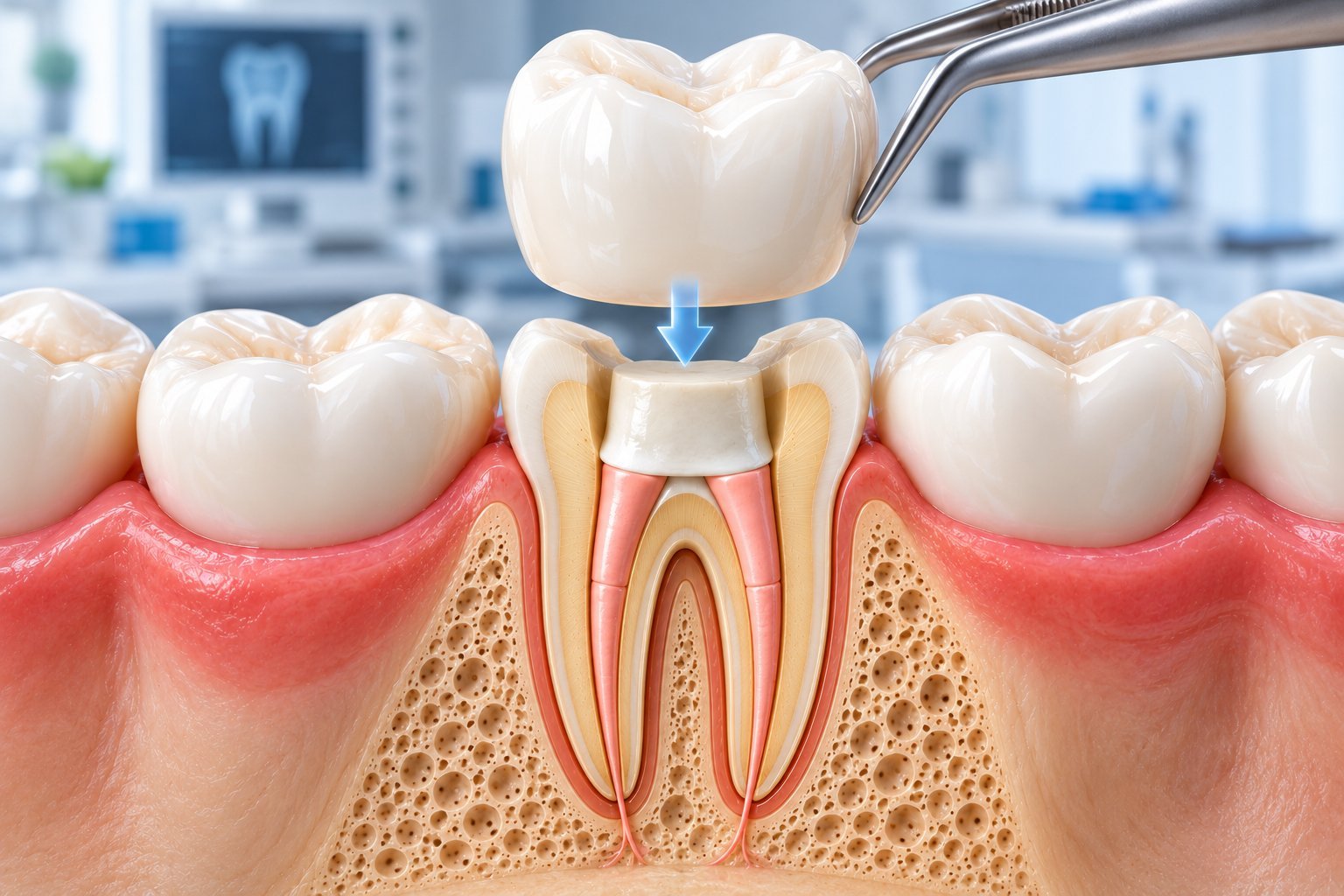
Many teeth need a crown after a root canal. The NHS says a crown, a cap that covers the whole tooth, may be needed if the tooth was badly infected. Cleveland Clinic says the crown is placed afterward to protect the tooth and restore your bite, and that you will likely have two more appointments for it: one to prepare the tooth and one to place the crown.
If the pain is getting worse, throbbing or still there after a week, call Pristine Dental Clinic in HSR Layout. The clinic is open every day from 9 am to 12 midnight.
Mild soreness is common. Cleveland Clinic says most people recover in less than a week, and the NHS says soreness and swelling should get better in a couple of weeks. Pain that gets worse or throbs is not normal, so call the dentist.
How long does pain last after a root canal?
For most people, a few days. Cleveland Clinic says pain should not last beyond about a week. If it does, or if it gets worse, see the dentist.
How many sittings does a root canal take?
The NHS says it usually takes 2 or more appointments of 1 to 2 hours each. The dentist tells you how many your tooth needs after the examination and X-ray.
Can I eat after a root canal?
Wait until the numbness wears off so you do not bite your cheek or tongue. Eat soft food for a few days, chew on the other side, and do not bite hard on the treated tooth until the crown is placed.
Can I smoke after a root canal?
It is best not to. Cleveland Clinic says smoking can slow healing. Ask the dentist for advice if you find it hard to stop.
Is it normal to have pain between root canal appointments?
Some soreness is common. The area around the tooth may feel sore while it settles, and the tooth only has a temporary filling, so avoid biting hard on it. If the pain throbs or gets worse, call the clinic.
Pain after a root canal that will not settle? Call the clinic.
Pristine Dental Clinic, 1703, 19th Main Road, Sector 2, HSR Layout. Open every day, 9 am to 12 midnight.
This article gives general information. It is not a diagnosis and does not replace a check by a dentist. If you have swelling near your eye or neck, or trouble breathing, swallowing or speaking, go to a hospital emergency department straight away.