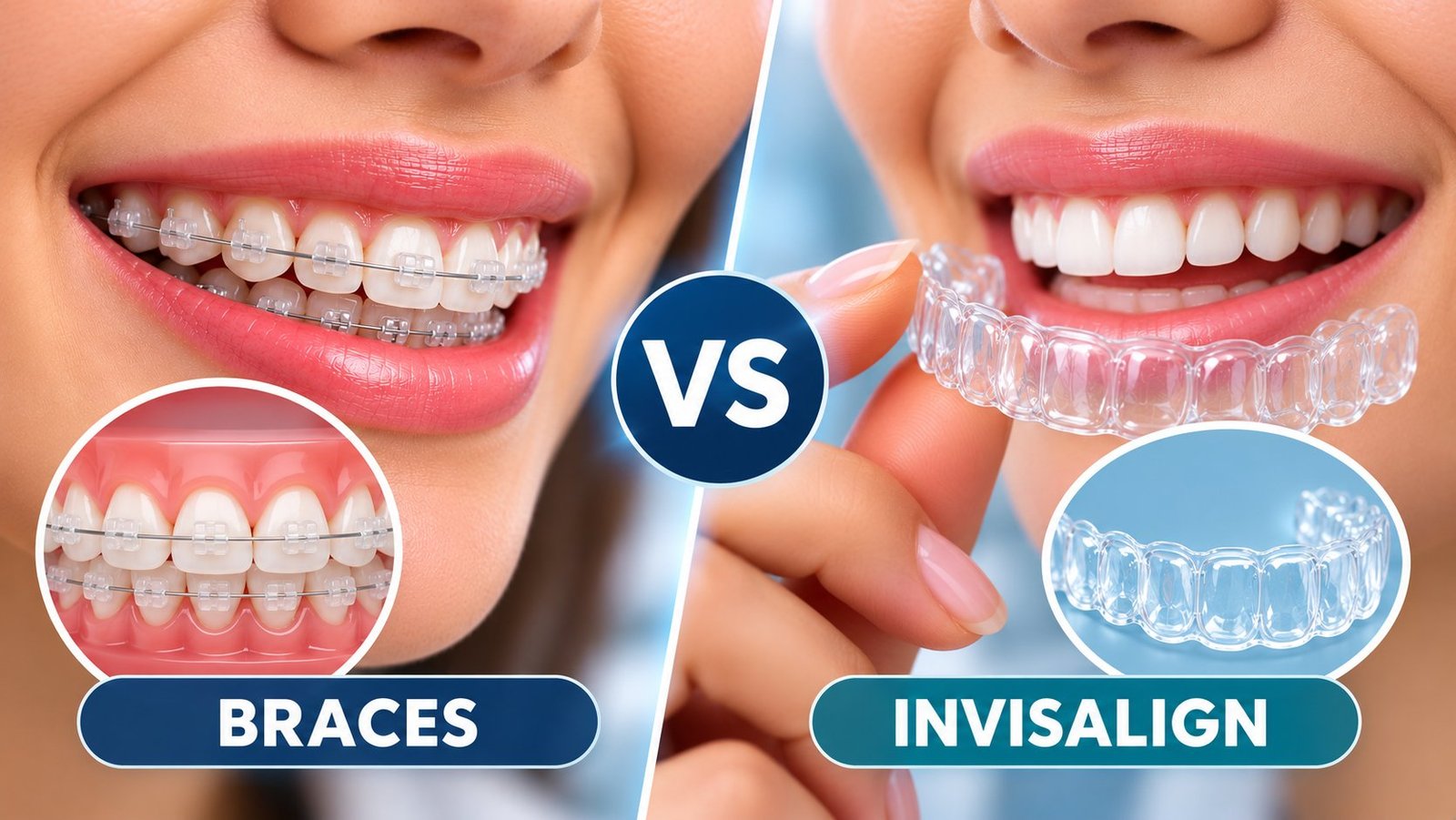
Adults can straighten their teeth too. The two main options are fixed braces and clear aligners such as Invisalign. Here is how each one works, what daily life is like with each, and the questions that help you choose.
Reviewed by Dr. Athhar Maswood K, BDS, Reg. No. 46747 A, Karnataka State Dental Council
Many adults put off straightening their teeth because they picture metal braces at work. Today there is more than one way to do it. Neither option is better for everyone. The right one depends on your teeth, your bite and how you live. Our page on braces and Invisalign in HSR Layout explains how treatment works at Pristine Dental Clinic.
Why adults choose to straighten their teeth
The NHS lists common reasons for braces: teeth that are too close together or stick out, upper and lower jaws that do not meet properly (an overbite or underbite), large gaps between teeth, or teeth that make it hard to chew or keep clean. These can be treated at any age. Braces are often done in the teen years, but adults can have them too.
How traditional metal braces work
With traditional metal braces, small metal brackets are glued to each tooth and joined by a wire. The wire puts gentle pressure on the teeth and moves them, little by little, into place. The brackets stay on for the whole treatment.
The NHS says your teeth may be sore for a few days after the braces are fitted, and that you will have a visit every 6 to 8 weeks to adjust them.
Ceramic braces: a less visible fixed option
Fixed braces do not have to be metal. As our braces page explains, braces can also be made of tooth-coloured ceramic. Ceramic braces work the same way as traditional metal braces, with a bracket on each tooth joined by a wire, but they are harder to see on the tooth. They are still fixed for the whole orthodontic treatment, so the food and cleaning advice for braces still applies.
How Invisalign treatment and other clear aligners work
Clear aligners are thin, clear, removable plastic trays made to fit your teeth. You wear a series of them, and each one moves the teeth a small amount. Invisalign is one well-known brand of clear aligners.
Aligners only work when you wear them. Invisalign's own guidance is to wear each aligner for 20 to 22 hours a day. They come out when you eat or drink, and Invisalign recommends that you brush and floss after each meal before putting them back in. Check-ups are about every 6 to 8 weeks.
Invisalign vs braces: pros and cons in daily life
Invisalign aligners
Traditional braces
Can you take them out?
Yes, removable
No, fixed for the whole treatment
How they look
Clear, more discreet
Easier to see
Food
Taken out to eat and drink
Avoid hard, crunchy or sticky food and chewing gum
Wearing time
20 to 22 hours a day
All the time
Check-ups
About every 6 to 8 weeks
Adjustments every 6 to 8 weeks
This is where most adults make up their mind.
Food and dietary restrictions. With fixed braces, the NHS advises avoiding hard, crunchy or sticky food, which can break the braces, and not chewing gum. With aligners, you take them out to eat, so food is less of a worry. But you must remember to put them back in.
Oral hygiene. With braces, food can catch around the brackets. The NHS advises brushing in the morning, at night and after meals, and using an interdental brush under the wire every day. With aligners, you brush your teeth and clean the trays before putting them back.
Looks. Aligners are clear and harder to notice. Braces are easier to see.
Discipline. Braces work all day because you cannot take them out. Invisalign treatment depends on you wearing the aligners for most of the day and night, so each tooth keeps moving as planned.
Which teeth problems suit which option
Both options can treat many cases of crowding, gaps and bite problems. Some cases are better suited to one than the other. This depends on how the teeth need to move and how much. It is decided after a check of your teeth and bite, often with X-rays, photos or scans. At this first consultation, the orthodontist looks at each tooth, any bite issues and how far each tooth needs to move, then makes a treatment plan for each option.
At Pristine Dental Clinic, braces and aligner treatment is planned with Dr. Rabab Khursheed, MDS in Orthodontics and Dentofacial Orthopaedics. She checks your teeth and bite and explains which option suits you.
How long it takes, and what comes after
Treatment time for either option usually ranges from several months to a couple of years, depending on how much each tooth needs to move to straighten your teeth. Invisalign says the average treatment for an adult is about 12 to 18 months. Your own timeline is given after the check.
Whichever you choose, you will need a retainer at the end. The NHS explains that a retainer stops the teeth moving back to where they were. The orthodontist tells you how long to wear it.
You can read Invisalign's answers on wearing time in the Invisalign FAQ.
Questions to ask at your first visit
Is my case suited to aligners, braces or both?
How long will my treatment take with each option?
How often will I need to visit?
What is the total cost, including retainers?
What happens if I do not wear aligners for the full time each day?
Want to know which option suits you?
Book a check at Pristine Dental Clinic in HSR Layout. You will hear which options suit your teeth, how long each would take and the cost, before you decide.
The cost depends on your teeth, how much they need to move and how long treatment takes. After a check, the clinic explains the cost of each option, including retainers, so you can compare.
Is Invisalign better than braces?
Neither is better for everyone. Both can treat many cases of crowding, gaps and bite problems. Some cases suit one more than the other. An orthodontist decides after checking your teeth and bite.
How many hours a day do I need to wear aligners?
Invisalign's guidance is 20 to 22 hours a day. You take them out to eat or drink, then brush and put them back in. Aligners only move your teeth while you wear them.
Can adults get braces?
Yes. The NHS notes that braces are often done in the teen years, but adults can have them too. Many adults choose clear aligners because they are harder to notice.
Do braces or aligners hurt?
The NHS says teeth may be sore for a few days after braces are fitted, and you may need soft food and a painkiller during that time. Tell the orthodontist if your teeth are painful for more than a few days.
How long does treatment take?
Usually several months to a couple of years. Invisalign says the average for an adult is about 12 to 18 months. Your own timeline is given after a check.
Thinking about straighter teeth? Call the clinic.
Pristine Dental Clinic, 1703, 19th Main Road, Sector 2, HSR Layout. Open every day, 9 am to 12 midnight.
This article gives general information. It is not a diagnosis and does not replace a check by a dentist. If you have swelling near your eye or neck, or trouble breathing, swallowing or speaking, go to a hospital emergency department straight away.